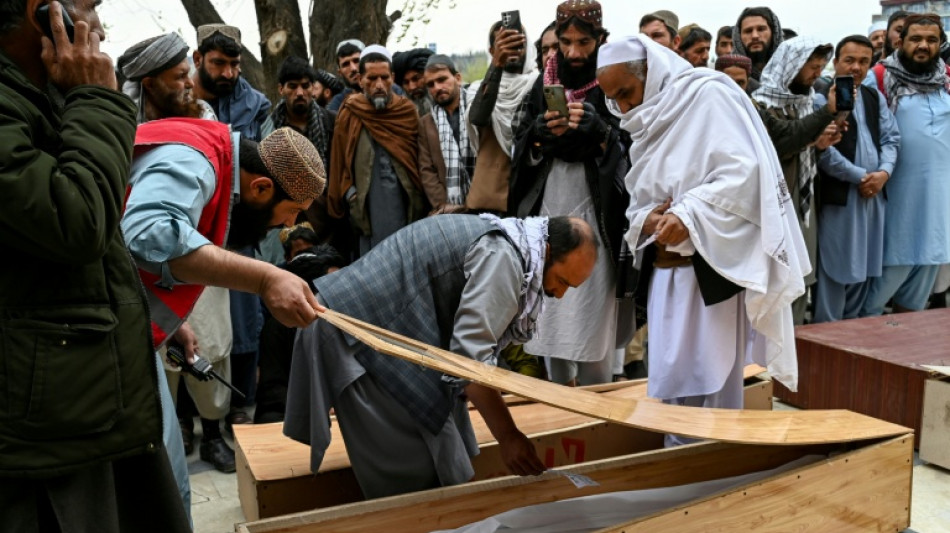
Families of Kabul bombing victims still search for answers / Photo: Wakil KOHSAR - AFP
Abdul Hai Hamidi gently opened each of the dozens of coffins, hoping to recognise one of his relatives who was killed in a Pakistani strike on a Kabul drug treatment centre.
But it left him none the wiser and like other loved ones, he prepared to carry on his search.
"He's the son-in-law of my brother. We've been searching for him after the strike but we haven't yet found him," he told AFP in front of the Eidgah mosque before a funeral for the victims on Thursday.
"We went to the hospitals but we weren't given any clue about him. His name is Samiullah and he was 30 years old."
The airstrike -- just days before the end of Ramadan -- hit a drug rehabilitation centre in the Afghan capital on March 16, prompting international condemnation.
Islamabad, which has been in conflict with Afghanistan for months, maintains that it hit a military target.
The force of the blast left many bodies torn apart, and it was difficult to identify some of the victims, the Norwegian Refugee Council, a humanitarian NGO, said after visiting the site shortly afterwards.
According to the spokesperson for the Afghan health ministry, Sharafat Zaman, the toll now stands at 411 dead and 263 wounded.
Two people died of their injuries and another person's body was found in the destruction since the Taliban government's first preliminary toll.
The UN mission in Afghanistan said its provisional toll was 143 dead and 119 wounded but added that was "very likely to increase".
"There are still bodies missing and hundreds of family members are contacting us," said Zaman. "There were rooms in the hospital where around 20 young people aged 18 or 19 were together.
"But everything was destroyed and their bodies have not been found."
- Reduced to ashes -
Samira Muhammadi went to the mosque to mourn her son, Aref Khan, 20, who dreamed of "becoming a good person, to help others", before he fell prey to drugs.
"They told me his body was completely burned, in ashes," she said. He had only been in the centre for a little over two weeks.
Muhammadi was not allowed to go onto the mosque forecourt where more than 50 wooden coffins were placed because she was not accompanied by a man, as required by the Taliban authorities' laws.
But later, at the cemetery where the victims were buried in mass graves, she looked in each coffin, hoping to find her son's remains. She couldn't find him.
In all, about 100 bodies have been buried in a mass grave in Kabul, according to the Afghan government. About 50 were interred last week. Others will be buried by their families privately.
Pakistan and Afghanistan have been in conflict for months, with Islamabad accusing Kabul of harbouring extremists who have carried out cross-border attacks on their territory.
The authorities in Kabul deny the accusation.
The conflict intensified on February 26, a few days after Pakistani airstrikes followed by a ground offensive by Afghan forces.
Both sides announced a truce for the Eid al-Fitr holiday marking the end of Ramadan, but that ended on Monday evening.
Burhanuddin Kamali also came to the mosque hoping for answers. He has been looking for news of his 21-year-old nephew, Mohammed Issa, who was working in an emerald mine in Panjshir province until he got into drugs.
"I haven't succeeded in finding his body," he said, showing a photo of a smiling young man on his phone.
"Everyone in the family, his mother and father, are sad," he added. "When someone is missing in the family, it's a different feeling."
V.Grabner--SbgTB