Ceasefire in Russia-occupied Ukrainian city holds for second day / Photo: Wojtek RADWANSKI - AFP
A US-brokered local ceasefire in southern Ukraine was holding for a second day, both sides said on Wednesday, as hopes grew that vital aid would be able to reach stranded residents.
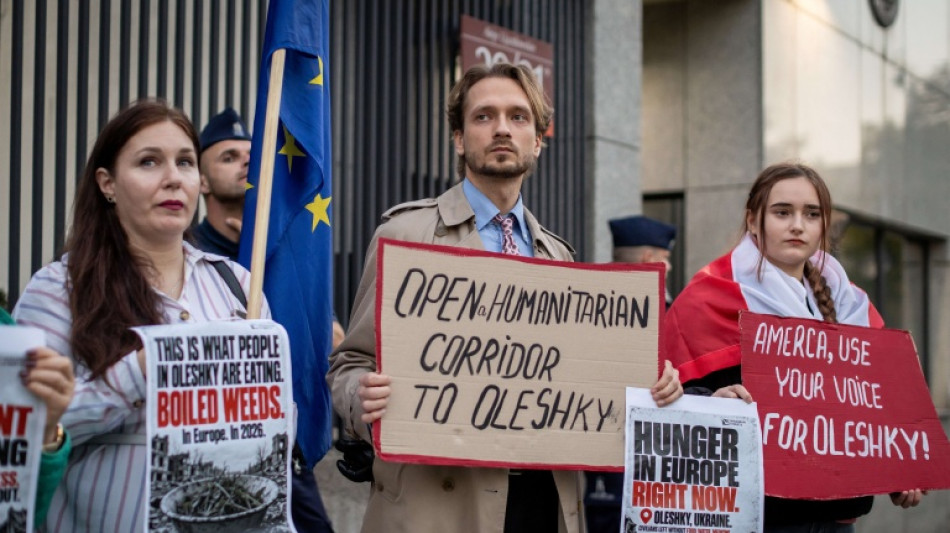
Locals in the city of Oleshky, under Russian occupation in Ukraine's southern Kherson region, have faced food, water and medicine shortages for months, caught in the crossfire between both sides.
Some of the estimated 2,000 people still there -- out of the pre-war population of 24,000 -- had resorted to hunting and eating pigeons, former residents who are still in touch with those in the city told AFP.
The human rights ombudsmen of both Russia and Ukraine said Wednesday that the truce -- which came into effect early Tuesday morning -- was still holding.
"30 hours of the ceasefire in Oleshky have passed without a single incident," said Ukraine's Dmytro Lubinets.
"No incidents have been recorded in the 30 hours of the ceasefire in Oleshky," Russia's Yana Lantratova said in a similarly worded statement.
The ceasefire will be guaranteed by "the physical presence of both ombudsmen: Ukrainian and Russian" on the ground, Lubinets's office told journalists.
Route demining was "currently underway", Lubinets said on social media, adding this was a "crucial step toward ensuring the safe delivery of humanitarian aid and enabling civilians who wish to leave the city to do so".
- 'Biggest de-escalation' -
Ukrainian President Volodymyr Zelensky said that since the ceasefire entered into force, there had been "no massive attacks" on the regional capital of Kherson, where around 280,000 people lived before the invasion.
"We're happy even when we have two, three days for these people. You know, some ceasefire is great, you can see them in the streets," he told reporters in The Hague.
He said the truce would be a "huge success" if the evacuation of Oleshky's citizens went ahead as planned.
It remains unclear how many people will choose to leave, or what route they will have to take.
Crossing the frontline -- marked by the Dnipro river -- is all but impossible, and Russian-installed officials have indicated they could have to travel through Russian-occupied Crimea.
They also said that most of those who wanted to flee had already done so.
A senior Ukrainian official also told AFP that many people in the city wanted to stay, so the ceasefire operation was designed to allow humanitarian supplies into the city.
The planned truce was announced by US First Lady Melania Trump last week after months of mounting international concern over the fate of residents in the city.
Oleshky was captured by Russian forces at the start of their 2022 invasion.
Lubinets said the truce was also bringing respite for the city of Kherson.
"Kherson, which had been under constant shelling, has literally come back to life. There are more people on the streets, and urban life has picked up," Lubinets wrote on social media.
"People are going outside without fear, taking walks and enjoying the autumn sunshine," he added.
He posted pictures of people selling fruit under anti-drone nets on the street and municipal workers mowing lawns amid buildings reduced to rubble.
The city lies on the Dnipro river, directly across from Russian forces on the opposite bank, and has been heavily bombarded throughout the war.
It was occupied by Russian forces at the start of the 2022 invasion, before Ukraine retook it in a counter-offensive later that year.
David Arakhamia, a Ukrainian lawmaker who took part in peace negotiations with Russia in 2022, described the ceasefire as the "biggest de-escalation since 2022".
Previous short-lived truces in the war -- such as to mark Orthodox Easter -- have seen drop-offs in aerial attacks but been marred by accusations of widespread violations by both sides.
V.Koch--SbgTB