Benjamin Netanyahu: Israel's longest-serving PM fighting for survival / Photo: Marc Israel SELLEM - POOL/AFP
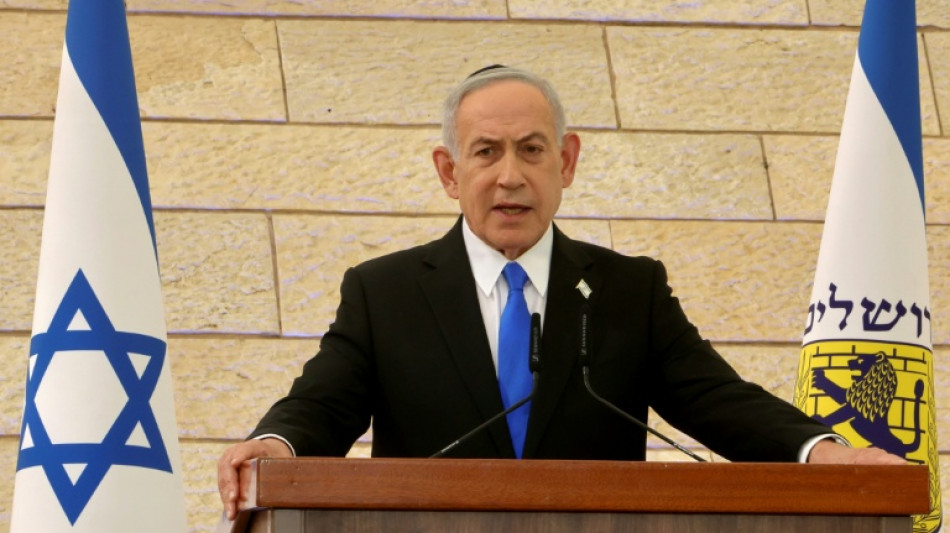
Prime Minister Benjamin Netanyahu, Israel's consummate political survivor, faces the fight of his life in Tuesday's election as he tries to convince voters he is still the only candidate capable of keeping them safe.
The 77-year-old's security-first reputation was all but shattered by Hamas's October 7, 2023 attack, and his main rival -- ex-military chief Gadi Eisenkot -- has channelled public anger over the failure and is running neck and neck with Netanyahu in polls.
Now Israel's longest-serving premier is pulling out all the stops, touting an endorsement from Donald Trump, warning that hostile powers want him to lose, and stoking fears of a Palestinian state -- opposed by a majority of Israelis -- should his opponents triumph.
His election campaign has leaned heavily on a single slogan, visible on posters throughout the country: "Either the Right or Palestine."
Off the campaign trail, Netanyahu faces an international arrest warrant over alleged war crimes in Gaza, a long-running corruption trial, and a spiralling multi-front conflict that has dragged on for three years.
But Netanyahu is hoping to use the wars he waged after October 7 to paper over that glaring security lapse, touting the military blows dealt to Hamas in Gaza, Hezbollah in Lebanon and the groups' backer Iran, which Israel has twice launched wars against.
Last week, after two Israeli soldiers were killed by Palestinian gunmen near Hebron, Netanyahu launched a major military operation in the occupied West Bank and vowed to "pursue Hamas terrorists" everywhere.
- Reshaping the Middle East -
Born in Tel Aviv on October 21, 1949, Netanyahu inherited his ideological background from his father Benzion, a former aide to Zeev Jabotinsky, leader of the so‑called "Revisionist" strand of Zionism that advocates for a "Greater Israel".
Netanyahu opposed, and eventually helped to bury, the Israeli-Palestinian peace process of the 1990s, which held a two-state solution as its ultimate goal.
He now promotes a vision of an Israel whose borders extend as far as Jordan, voicing support for annexing parts of the occupied West Bank and undertaking measures to promote the growth of Israeli settlements which are illegal under international law.
As a younger man, Netanyahu served in an Israeli commando unit and fought in the 1973 Arab-Israeli war.
His early life's defining tragedy came when his elder brother Yonatan was killed leading the Entebbe hostage-rescue mission in Uganda.
"When the news reached me that Yoni had died, I felt as if my life had ended," Netanyahu later wrote.
Raised partly in the United States and a graduate of the Massachusetts Institute of Technology (MIT), he became one of Israel's most visible spokesmen abroad, showing an ease on US television that has never left him.
Elected to parliament in 1988, he took over leadership of the right-wing Likud party in 1993. In 1996, in the first election after the assassination of peace-negotiating Yitzhak Rabin, Netanyahu pulled off an upset victory by the tiniest of margins and at age 46 became the youngest prime minister in Israeli history.
He served as head of government from 1996 to 1999, then again from 2009 to 2021, before returning to power in late 2022 by cobbling together a coalition that includes once-shunned extremists.
For years, Netanyahu maintained that the foundations of Israel's security rested on military strength but he also gained a reputation for caution.
Adamantly opposed to a Palestinian state, Netanyahu saw Hamas rule in Gaza, which was bankrolled by Qatar, as a way to divide Palestinians and weaken the West Bank-based Palestinian Authority, which enjoys strong European support.
The Hamas attack exposed the failures of this setup. As the war in Gaza widened, Netanyahu began to frame the conflict as a generational struggle intended to reshape the region and uproot the influence of Iran's clerical state.
In recent months, he has repeated the refrain that he "changed the face of the Middle East".
- 'He spreads hatred' -
His supporters credit him with responding to Israel's darkest hour with unprecedented military resolve, and confronting Tehran directly -- something none of his predecessors had done.
Critics, however, say his actions have mired the country in intractable conflicts and made it a pariah on the world stage.
His rival Eisenkot has declared that Netanyahu "is unfit to remain in office".
"He spreads hatred, fear and portrays his rivals as enemies of Israel," Eisenkot told public broadcaster Kan.
But Netanyahu still has a powerful ally in US President Trump, whom he has called "the greatest friend Israel has ever had" in the White House.
He received the US president's endorsement 10 days before the vote, with Trump assuring him that he was "the man I want by my side".
Polls show Netanyahu is unlikely to be able to form a government on his own. But for decades, he has defied predictions of his downfall.
On Channel 14, a private station that supports him unquestioningly, he recently declared that the stakes of these elections were "the continued existence of the Jewish state, and to guarantee that, you must vote for the person who will get the job done".
W.Strasser--SbgTB