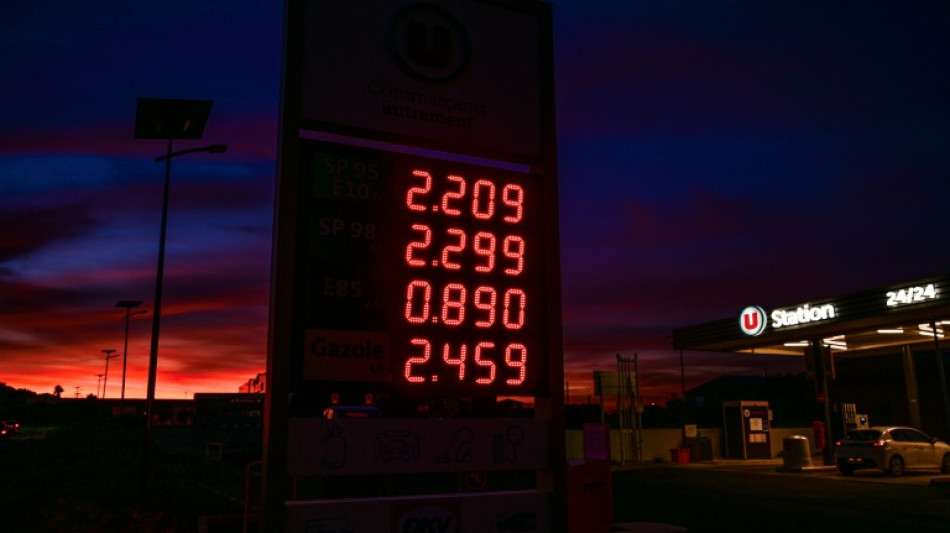
G7 talks as US pressures Europe over diesel stocks / Photo: Gabriel BOUYS - AFP
G7 leaders were holding talks Friday to coordinate action on fuel prices, after the United States upped pressure on Europe to release its strategic reserves, threatening a diesel export ban.
The US war with Iran has sent energy prices skyrocketing, coming back to bite President Donald Trump at home with high fuel costs, a key issue in the run-up to midterm congressional elections next month.
After speaking with Trump, France's President Emmanuel Macron convened a video call starting at 1230 GMT of G7 leaders -- a group comprising also Britain, Japan, Canada, Germany and Italy -- to discuss joint action.
Earlier the EU pushed back hard against US threats to impose a diesel export ban -- something Macron also warned against during his conversation with Trump.
"We fully reject any ban on diesel. A ban would not be beneficial to anyone. It would undermine our trust in the United States as a reliable partner," European Commission spokeswoman Anna-Kaisa Itkonen said.
The 27-nation bloc was ready to work with the International Energy Agency on the possible release of fuel reserves to contain prices, she added, following crisis talks between member states and the commission to forge a unified response.
- US pressure -
The flurry of diplomatic activity came a day after US Treasury Secretary Scott Bessent cranked up the pressure on European nations.
"Our European partners should accelerate delivery on their existing commitments and make additional supplies immediately available to address ongoing disruptions," Bessent posted on social media.
"American farmers, truckers, and businesses should not be left carrying the burden of a global diesel shortage," he wrote.
Earlier this week, the head of the International Energy Agency (IEA), Fatih Birol, said European nations were yet to release part of the stocks they had agreed to in an earlier bid to ease prices in March.
"A big chunk of the stocks have been released, but still some remain, both in terms of crude oil and products," Birol told reporters Tuesday after a meeting of EU energy ministers in Dublin.
The 32 members of the IEA agreed last March to unlock 400 million barrels of oil from reserves, their largest release ever.
About a third was yet to come to market, Birol said, adding that further releases were possible with 80 percent of overall IEA stocks "still in our pocket".
Diesel prices in the United States and Europe have hit record highs due to the US-Iran war, with an export ban imposed by major producer Russia in response to Ukrainian attacks on fuel facilities also contributing to global market pressures.
The issue has emerged as a major drag for Trump's Republican Party in the coming midterm elections, in which it risks losing control of Congress.
- 'Dramatic consequences' -
Trump on Wednesday floated the possibility of banning US exports of diesel, which is used in trucks and other hauling vehicles -- an alarming prospect for the EU, which relies heavily on fossil fuel imports.
EU trade chief Maros Sefcovic told reporters Thursday on the sidelines of the G20 trade ministers gathering in Milwaukee that the ban would have "dramatic consequences for our economic performance."
Reports said the Trump administration wants France and Germany in particular to tap their stockpiles of diesel to try to curb prices.
"It is in Europe's best interest to work with the United States as we pursue multiple pathways to boost the supply of refined products and lower costs for consumers," a US official told AFP.
The German government Friday also called for "coordinated and reciprocal solutions", warning against unilateral actions that could destabilise global fuel markets.
Further EU discussions at ambassador-level were scheduled for Friday afternoon, with Brussels denying its stance on the fuel price crisis was being dictated by US pressure.
"These meetings that we've been holding have nothing to do with recent indications, threats, whatever you may call them," commission spokeswoman Paula Pinho said, noting diesel prices had doubled in Europe since February.
Energy price increases in the eurozone surged to 18.8 percent in September, pushing inflation to 3.8 percent, the highest level in three years.
H.Kohl--SbgTB