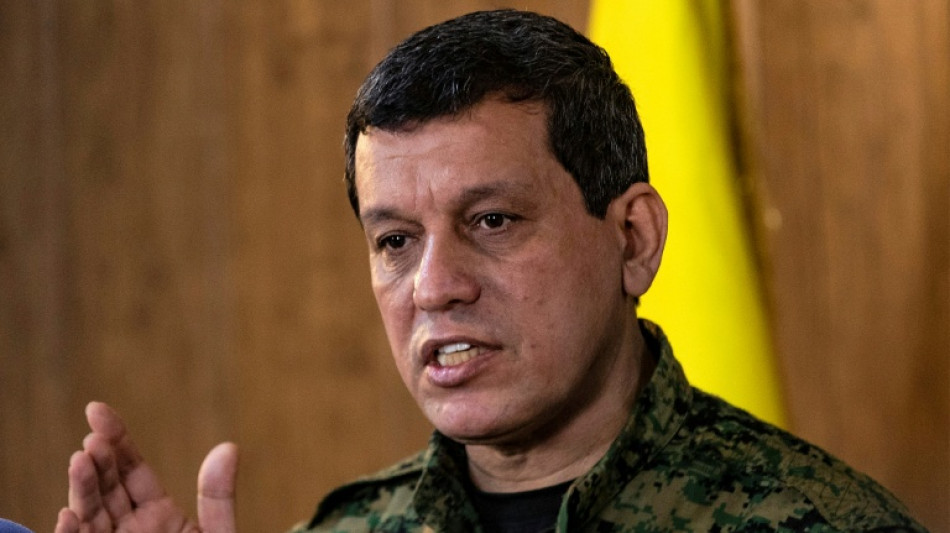
Syrian Kurdish leader dissolves force that spearheaded jihadist fight / Photo: Delil SOULEIMAN - AFP/File
The leader of the Kurdish-led Syrian Democratic Forces, the Washington-backed group at the forefront of the battle against the Islamic State jihadist group, announced their dissolution on Tuesday under a deal with the government.
After being Syria's most highly trained and organised paramilitary force for years, the SDF was promptly dropped by Washington in favour of the new US-friendly authorities in Damascus after the ousting of longtime ruler Bashar al-Assad in late 2024.
The forces' leader, Mazloum Abdi, declared their dissolution in a televised speech at the presidential palace in Damascus.
"We announce today the end of the mission of the Syrian Democratic Forces and declare, with full responsibility, their dissolution as an independent military force," he said.
Abdi explained that the announcement followed "the completion of the process of integrating our forces into the brigades of the Syrian army".
The SDF was formed in 2015 at the instigation of the United States, which was impressed by the Kurdish fighters who had defeated IS in Kobane in the north and was seeking a reliable partner in the ongoing battle against the jihadists.
The group went on to spearhead the battle against IS, which was defeated territorially in Syria four years later.
The US special envoy to Syria and Iraq, Tom Barrack, hailed the group's disbandment on Tuesday.
"This is what real integration looks like: not winners and losers, but former counterparts with differing points of view crafting a diplomatic solution to strengthen the sovereign nation of Syria. One army, one government, one state," said Barrack, who is also Washington's ambassador to Turkey.
- 'Circumstances have changed' -
"Since the creation of the SDF, its fighters have shouldered a heavy responsibility during one of the most difficult periods" for Syria, Abdi said in his address.
"They liberated many Syrian cities and towns, first from the Baathist regime, then from the terrorism of Daesh," he continued, using the Arabic acronym for IS.
"The circumstances have changed today and the country has entered a new phase characterised by peace and participation."
The SDF amassed around 100,000 fighters at its peak, both Kurds and Arabs, and controlled swathes of Syria's oil-rich north and northeast.
But following January clashes that saw the Kurds lose large chunks of territory to government troops, the two sides signed a deal to integrate Kurdish military and civilian institutions into the state.
During the violence, Syrian President Ahmed al-Sharaa signed a decree enshrining the Kurds' national rights and recognising Kurdish as a national language, an unprecedented step since Syria's independence in 1946.
- Win for Sharaa -
Arabs within the SDF's ranks also defected en masse after Sharaa's army took control of two previously Kurdish-held provinces, Raqa and Deir Ezzor, leaving them at half their strength, according to Syria specialist Fabrice Balanche.
The Kurdish force faced repeated Turkish invasions between 2016 and 2019, with Ankara saying it wanted to push the fighters away from its border.
Turkey has long viewed the SDF as linked to the militant Kurdistan Workers' Party (PKK), which waged a decades-long insurgency in the country.
The January agreement, under which Kurdish fighters would be integrated into state structures, stipulates that the SDF commit to expelling all non-Syrian PKK leaders and members from the country.
The SDF's integration into the state is a major victory for Sharaa, who has been trying to cement control over all of Syria since Assad's fall.
However, the deal represented the last nail in the coffin for the Kurds' long-held dream of autonomy.
Last week, Abdi announced that the integration of the Kurdish administration with the Syrian state was complete, adding: "Our struggle will continue, to cement our people's rights in the constitution."
B.Schellnegger--SbgTB