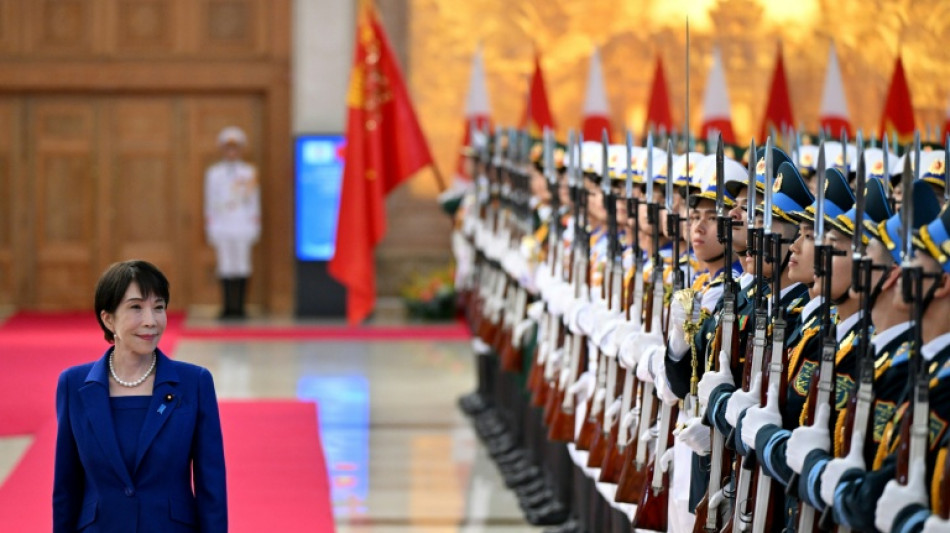
In Vietnam, Japan PM vows more effort to keep Asia 'free and open' / Photo: Nhac NGUYEN - POOL/AFP
Japan's prime minister vowed Saturday to do more to ensure a "free and open Indo-Pacific", using a speech in communist Vietnam to tout a regional strategy that has long rankled neighbouring China.
"I am renewing my determination to fulfil Japan's responsibilities and... to play an even more proactive role than ever before in building an international order based on freedom, openness, diversity, inclusiveness, and the rule of law," Sanae Takaichi said in an address at a Hanoi university.
In an era of "intensifying geopolitical competition, accelerating technological innovation", the Japanese premier called for Asian countries to cultivate "resilience" and the ability to "determine their own future".
Japan and Vietnam share common concerns about China's territorial claims in the East and South China Seas, and both have sought to hedge against US-driven trade disruptions by broadening economic and security ties.
But Hanoi aims to stay on good terms with all global powers through its traditional "bamboo diplomacy" approach, while Tokyo has seen its already frosty relations with Beijing deteriorate markedly in recent months.
That makes Vietnam a striking choice of venue for a Japanese foreign policy speech touting a strategy backed by Washington and closely associated with US President Donald Trump.
First articulated a decade ago by Takaichi's mentor Shinzo Abe, the idea of a "free and open" Indo-Pacific has since been embraced by multiple US partners and allies seeking to curb China's influence in the region.
Beijing has slammed the initiative as veiled attempt to promote bloc confrontation, with Chinese foreign ministry spokesman Lin Jian accusing Tokyo of "stirring up confrontation between camps".
In her address Saturday, Takaichi said she was updating the diplomatic vision for a "challenging" new era.
Without naming Beijing directly, she warned against "excessive dependence on a single country for critical goods", saying this often results from "unduly low prices" and calling for a "level playing field".
She also underscored the importance of open shipping lanes, saying "regional supply chains are underpinned by the safe and open navigation of sea".
- Taiwan tightrope -
Long considered a China hawk, Takaichi drew a sharp rebuke from Beijing in November when she suggested that close US ally Japan might intervene militarily to thwart any Chinese attempt to take Taiwan.
China, which regards democratic Taiwan as part of its territory and has not ruled out using force to annex it, summoned Japan's ambassador, warned Chinese citizens against visiting Japan and imposed trade restrictions.
Japan, which like others in the region has territorial disputes with China, has moved to deepen security cooperation ties, in particular with the Philippines.
Takaichi, on her first visit to Vietnam since becoming prime minister in October, aims to deepen bilateral cooperation on energy security and supply chain resilience amid major disruptions stemming from the Middle East crisis.
Japan is Vietnam's largest provider of official development assistance and a key investor and trading partner, with two-way trade surpassing $50 billion for the first time last year.
Takaichi met Saturday with Prime Minister Le Minh Hung as well as top leader To Lam, the Communist Party boss who last month became president as well.
They agreed to advance their high-level strategic partnership to a "new phase of development", Hung said, and inked six agreements spanning technology, climate preparedness and information and communication.
The two sides also agreed to deepen security cooperation and "reaffirmed the importance of resolving disputes in the South China Sea through peaceful means based on international law," according to the Vietnamese prime minister.
Prior to her speech, Takaichi said "Vietnam highlights strategic self-reliance with a positive and active external foreign policy".
"Therefore, increasing cooperation with Vietnam is extremely important for the realisation and progress of (a) free and open Indo-Pacific".
Takaichi will travel to Australia after departing Vietnam on Sunday.
D.Brunner--SbgTB