Israel strikes Iran as Trump says Tehran wants deal to end war / Photo: CHIP SOMODEVILLA - GETTY IMAGES NORTH AMERICA/AFP
Israel launched strikes across Iran on Thursday, hours after US President Donald Trump said Tehran wanted a deal to end the nearly four-week war despite its top diplomat rejecting any talks with Washington.
The conflict has mushroomed to draw in nations around the Middle East, sending energy markets into a tailspin and threatening to torpedo the global economy.
Iran, under near-daily bombardment since a joint US-Israeli attack started the war on February 28, was hit early Thursday by what the Israeli army said was "a wide-scale wave of strikes targeting infrastructure", including in the central city of Isfahan.
In turn, an Iranian missile attack activated sirens across central Israel including Tel Aviv and parts of Jerusalem on Thursday morning, according to the Israeli military, the first launches it identified from Iran in more than 14 hours.
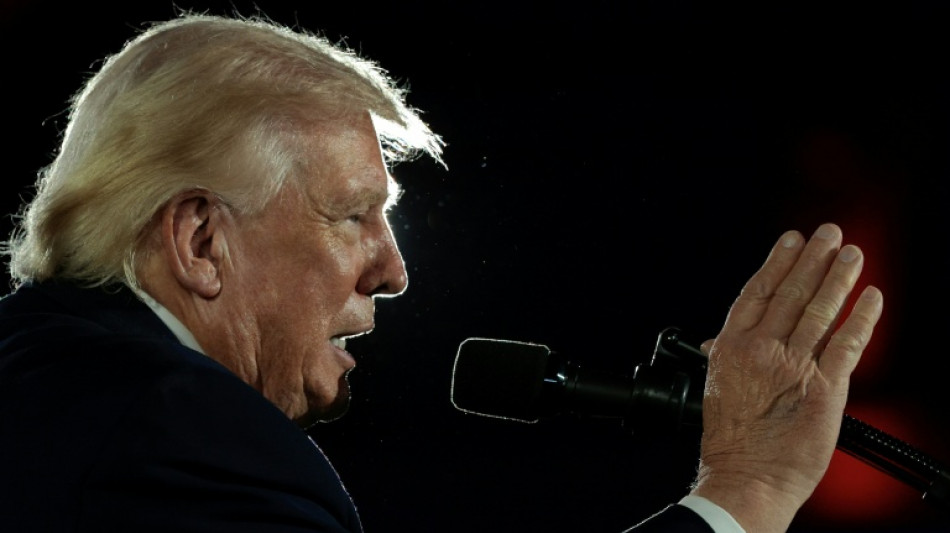
Trump, whose daily statements have swung wildly from threatening to conciliatory, said talks to end the war were ongoing with Iran, but that officials in Tehran were covering them up out of fear.
"They are negotiating, by the way, and they want to make a deal so badly," Trump told a dinner for Republican members of Congress.
"But they're afraid to say it, because they figure they'll be killed by their own people," he said. "They're also afraid they'll be killed by us."
The Islamic republic's top diplomat slapped down Trump's comments, saying the country did not intend to negotiate.
"We seek an end to the war on our own terms, of course, and in a way that it will not be repeated here again," Foreign Minister Abbas Araghchi told state TV.
Pakistan has passed on a 15-point US plan to stop the fighting to Tehran, two officials in Islamabad said.
But Iran's state-controlled Press TV cited an unidentified official saying Tehran had "responded negatively" to the proposal.
White House Press Secretary Karoline Leavitt said Trump "does not bluff and he is prepared to unleash hell" on Iran if no deal is struck.
China's top diplomat Wang Yi meanwhile said Thursday that signs both sides could be open to talks offered a "glimmer of hope" for peace.
- Iranian conditions -
According to The New York Times, the 15-point US plan touches on Iran's contested nuclear and missile programs as well as "maritime routes".
Tehran has largely blocked the vital Strait of Hormuz oil route in retaliation for the US-Israeli attacks, pushing up global energy prices.
The Iranian official quoted by Press TV said Tehran had put forward its own five conditions for hostilities to end.
These include guarantees that the United States and Israel do not resume the war and compensation for war damages.
Iranians marched in support of the country's military in the capital Tehran on Wednesday, waving the country's flag and holding pictures of new supreme leader Mojtaba Khamenei.
The head of the US Central Command, Admiral Brad Cooper, said on Wednesday that Washington has hit two-thirds of Iran's production facilities for missiles and drones, and a similar proportion of its naval production.
Iran has still kept up retaliatory attacks on Israel and Gulf nations that it accuses of serving as launchpads for US strikes.
Saudi Arabia said it intercepted at least 18 drones, while the United Arab Emirates responded to a new missile and drone attack and Bahrain reported a fire at a facility caused by "Iranian aggression", without providing further details.
Kuwait also reported a new missile and drone attack on Thursday, a day after a drone hit a fuel tank and sparked a fire at Kuwait International Airport.
- No Lebanon 'surrender' -
The war has also drawn in Lebanon after pro-Iran Hezbollah began firing rockets into Israel on March 2 to avenge Khamenei's killing.
Hezbollah chief Naim Qassem said negotiations with Israel would amount to "surrender", before the group launched missiles early Thursday at military sites in central Israel, where air raid sirens sounded.
The militant group said its fighters launched more than 80 attacks against Israel on Wednesday, the largest daily number in the current war, and attacked Israeli forces in nine border towns.
As the fighting showed little sign of respite, Israeli Prime Minister Benjamin Netanyahu said the military had "created a genuine security zone" in southern Lebanon and was expanding it.
"We are simply creating a larger buffer zone" that could prevent a ground invasion of Israel and missile attacks, he said in a video shared by his office.
UN Secretary-General Antonio Guterres called on both sides to stop fighting.
- Markets mixed -
With thousands more US troops reportedly headed to the Middle East, Iran also threatened to open a new front by targeting Red Sea shipping should the United States launch a ground invasion.
In the event of a US ground invasion, Iran would block the Bab el-Mandeb Strait, which connects the Indian Ocean to the Red Sea and the Suez Canal, an unnamed military official told local media.
The divergent messages on talks and de-escalation saw oil prices rise Thursday and equities mixed as developments were tracked by investors recently buoyed by Trump appearing to step back from the goal of regime change earlier in the week.
But while crude prices are down from last week, uncertainty and the continued closure of the Strait of Hormuz -- through which 20 percent of oil and gas passes -- continued to cast a shadow.
"There is no reason to allow the ships of our enemies and their allies to pass," he said.
Pakistan's defence minister, whose government has offered to host talks between Iranian and American envoys to stop the war, appeared to take a jab at the US operation that has closed the key waterway.
"The goal of the war seems to have shifted to opening the Strait of Hormuz, which was open before the war," Khawaja Asif posted on X, alongside hand-clapping emojis.
burs-jfx/ceg
U.Hauser--SbgTB