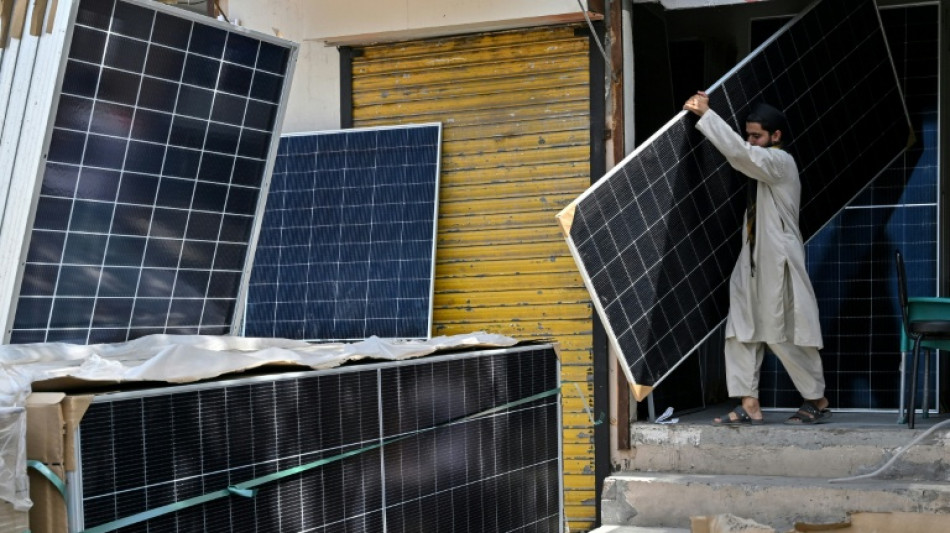
Renewables hit record in 2025, but world must move faster: report / Photo: Arif ALI - AFP/File
Global renewable power capacity grew by record levels last year, a report showed Monday, hailed as a sign by the UN climate chief that the "brute power of market forces" is making the transition to clean energy irreversible.
The report by the International Renewable Energy Agency (IRENA) was published as world leaders gather for the United Nations General Assembly following a record-hot northern hemisphere summer underscoring the worsening impacts of human-caused climate change.
IRENA's report found that 693 gigawatts (GW) of new renewables power was added in 2025. That is over half the installed capacity of the entire United States.
But to meet a global goal of tripling renewable energy by the year 2030 -- a key target agreed by countries at the COP28 talks held in 2023 -- the world still needs to more than double today's levels, which stand at 5.15 terawatts (TW).
A terawatt is equal to 1,000 gigawatts.
If the growth rate recorded in 2025 holds, the world would reach 10.6 TW by 2030, about 0.6 TW short of the 11.2 TW goal. That gap has narrowed from 0.9 TW in last year's assessment.
"Thanks to global renewables, humanity avoided almost half a trillion US dollars in fossil fuel costs," Simon Stiell, executive secretary of the UN Framework Convention on Climate Change (UNFCCC), said at an event called the Industry Acceleration Summit.
"That's a mammoth decarbonization dividend," he said. "That's more than the national GDP of over three quarters of countries on Earth."
Renewables remained the most cost-competitive source of new electricity in most markets in 2025, the report found.
"The brute power of market forces is taking hold," said Stiell, adding: "The shift to clean energy is now irreversible."
But the report also found the world was still well behind on the goal of doubling the rate of energy efficiency improvement by 2030, and made multiple recommendations including upgrading electric grids, and combining solar, wind and battery storage to get cost-competitive power around the clock.
David Waskow, director of the international climate initiative at the nonprofit World Resources Institute, cautioned that the positive news is tempered by the fact that renewables are not yet displacing enough fossil fuel use as global energy demand rises.
He told AFP rising demand for cooling in a warming world, along with AI and data centers, were the two largest drivers of increasing energy demand.
"We're going to need to not only push farther and faster on renewables, on electrification as well, but also to make sure that we're reducing the level of fossil fuel consumption," he said.
The Energy Institute's Statistical Review of World Energy, published in June, found fossil fuels still supplied 86 percent of global energy in 2025, and that fossil fuel use continued to grow in absolute terms.
Y.Kraus--SbgTB