Rob Bugden Rebuilds Life After Parachuting Accident That Left Him Tetraplegic
Rob Bugden, a former Royal Air Force parachute instructor, was left tetraplegic after a mid-air collision with a fellow trainee during a high-altitude jump in Arizona in January 2016. Despite the life-altering injury that ended his military career, Bugden has rebuilt his life through rigorous rehabilitation, athletic challenges, and extensive charitable advocacy for injured veterans.
Rob Bugden, a former Royal Air Force parachute instructor, was left tetraplegic after a mid-air collision with a fellow trainee during a high-altitude jump in Arizona in January 2016. Despite the life-altering injury that ended his military career, Bugden has rebuilt his life through rigorous rehabilitation, athletic challenges, and extensive charitable advocacy for injured veterans.
The accident occurred on January 21, 2016, marking the final day of Bugden’s high-altitude training in the United States. He was one of eight trainee parachutists performing a jump from 12,000 feet. After exiting the aircraft, Bugden stabilized his body by arching his back and monitored his speed and altitude via his watch. As he neared the ground and deployed his parachute, he confirmed the canopy was functioning correctly before losing consciousness.
"I looked up. Good canopy," Bugden recalled. "But then: Cut to black. And I’m waking up in a hospital in Phoenix."
The loss of consciousness resulted from a collision with his friend and fellow trainee, Brook Stebbings. The pair were attempting to form a landing stack, a vertical queue of parachutists holding pattern at different altitudes before descent. At approximately 1,000 feet, Stebbings’ knee struck Bugden’s neck, fracturing his spine. Both men fell into the desert sand entangled, an image that ground team members later described as resembling "a bag of washing above our heads."
A special forces unit responded immediately to stabilize the pair and prevent further spinal injury. Stebbings was transported to a hospital in Palm Springs with a broken leg and torn kidneys. Bugden was airlifted by helicopter to St Joseph’s Hospital in Phoenix, where medical staff worked to save his life. The surgery involved inserting metal fixations to stabilize his neck and reconstructing his eye socket.
The severity of the trauma required extensive life-support measures. Because the injury caused paralysis, doctors performed a tracheostomy to assist with breathing and inserted a percutaneous endoscopic gastrostomy tube for nutrition. A pacemaker was also implanted due to dangerously low heart rate fluctuations.
When Bugden regained lucidity in the hospital, his first coherent thought concerned his brother, who had served in numerous conflict zones including Northern Ireland, Sierra Leone, Kosovo, Bosnia, Iraq, and Afghanistan. "What’s my brother done?" he wondered, assuming his sibling was the one hospitalized. When his brother entered the room alongside their parents, whose marriage had ended when Bugden was five years old, the reality of the situation became clear.
"It was: ‘Oh, what the hell have I done?’" Bugden said.
Born in Cornwall to a military family, Bugden viewed his career path as an extension of his heritage. Three of his grandparents served in the air force, and his father spent 22 years in the Royal Navy. His brother remains active in the army. "I always say it’s a bit like the family business," Bugden noted. "It was always going to happen."
Before joining the military, Bugden attended university in Cardiff, where he studied sports coaching and competed as a long-distance runner for Great Britain under 23s. In 2006, he was part of the British team alongside Mo Farah, who won the European cross-country title that year. When Olympic prospects faded, Bugden enlisted in the air force in 2008.
He completed basic training at RAF Halton in Buckinghamshire and specialized as a physical training instructor. After a deployment to the Falkland Islands, he pursued qualification as a parachute jumping instructor in March 2015, overcoming a fear of heights. He noted that he never lost his fear but learned to face it, citing jumps from 20,000 feet at night without hesitation.
Due to unfavorable weather conditions in the UK, the air force relocated Bugden to Blythe, Arizona, for high-altitude training. His professional goal was to instruct special forces units on missions such as the Tristan da Cunha rescue operation, where paratroopers and medical clinicians were deployed to a remote island to assist a British national with suspected hantavirus.
"It was so, so cool," Bugden said of the operation. "I would have taught them to freefall."
The accident occurred three weeks after this final jump. Following extensive testing, surgeries, and medication that caused fluctuating consciousness, Bugden was medevaced to the UK. The flight flew low over the Atlantic to minimize spinal compression. Upon arrival, the full extent of his injuries was confirmed: severe damage to his spinal cord had left him tetraplegic, affecting all four limbs, requiring round-the-clock care for the remainder of his life.
For the first four months post-accident, Bugden had no mobility. He required assistance for all basic functions, including feeding, brushing his teeth, and washing. Beyond mobility, he faced significant challenges with bladder, bowel, and sexual function, making natural conception difficult. He also struggled with temperature regulation and weight management.
Rehabilitation lasted ten months before he regained some independence. He learned to manage his catheter independently and practiced standing with assistance to improve bodily functions, prevent muscle spasms, and experience his former height briefly. "I’m 6ft 3in," Bugden said. "It’s quite nice being tall."
He continued his recovery at a military hospital in the Midlands, citing the camaraderie and humor among injured personnel as crucial to his mental health. He recalled observing fellow patients with severe injuries engaging in typical banter, noting an informal "injury hierarchy" where he jokingly referred to leg amputations as "flesh wounds." It took four years for him to be fully discharged from rehabilitation.
"One of the biggest tools is patience," Bugden said. "Things don’t happen quickly, and that’s not just your rehabilitation." He described recovery as a series of peaks, plateaus, and dips, emphasizing that enduring the lowest points was necessary because lying in bed was the most difficult period.
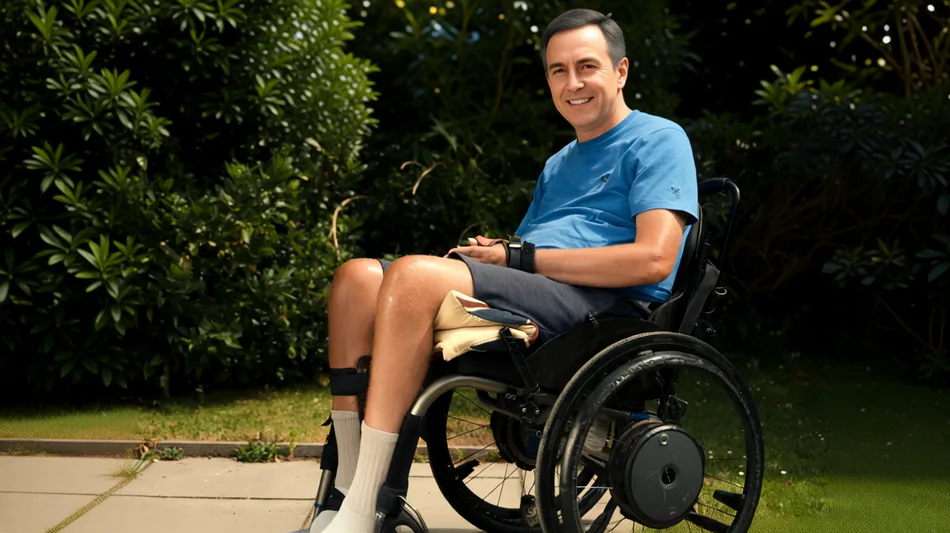
Bugden now resides in an adapted bungalow in Sigingstone, a rural village in the Vale of Glamorgan, Wales. He lives with Denzel, whom he describes as his "lack of assistance dog." His health is stable, and he operates his wheelchair with ease. His home is decorated with sporting memorabilia, including England running vests, a signed shirt from his favorite rugby team, the Cornish Pirates, and images from his RAF training days.
His social life remains active, centered on sports and friendship. Friends who were present during the accident, Aaron and Mat, continue to train military parachutists and visit Bugden regularly. "I’m exceptionally fortunate with the support and help I’ve had all the way along," Bugden said. "These boys, first and foremost, without them I would be a mess."
He emphasized that his friends do not treat him with excessive caution. "I can still chat bollocks to the best of them," he said. "And I can still get out and do things. I just have to do them differently now." He recalled early moments of humor, such as a friend feeding him while making airplane noises, which brought laughter during a dark time.
Following the accident, Bugden’s friends established a rugby team named Horus, after the Egyptian god of the sky, to unite military families and raise funds for charities supporting injured veterans, including the RAF Benevolent Fund and Cakes for Casualties. The team set a world record for the longest game of rugby sevens and tens, lasting over 24 hours. Bugden described this initiative as one of the most important aspects of his rehabilitation.
Medically discharged from the air force, Bugden now lives on his military pension but remains closely involved with the military community and associated charities. He serves as an ambassador for Sandville, a Welsh charity supporting individuals with life-limiting conditions such as spinal injuries, Parkinson’s disease, and dementia. He is also a beneficiary of the Royal Air Force Benevolent Fund, which he described as essential to his survival.
His advocacy extends to Blesma, The Limbless Veterans; Help for Heroes; and the OppO Foundation, organizations that assist veterans with disability, mental health, and financial challenges. While acknowledging progress in accessibility, Bugden noted that significant barriers remain for wheelchair users. "We’ve got a long way to go for how things are set up for people in wheelchairs," he said. "We’re a lot better than we were and we are moving in the right direction … but there are still certain places I can’t get in."
In 2023, Bugden competed in five half-marathons across Wales using a custom-built sports wheelchair, raising £8,000 for various charities that supported him. He spent months training his shoulders and biceps using a ski machine to build upper-body strength. He expressed interest in undertaking further physical challenges.
Reflecting on his journey, Bugden cited the 1999 film *Any Given Sunday* as a guiding philosophy. He quoted Coach D’Amato’s speech: "We can stay here and get the shit kicked out of us, or we can fight our way back into the light. We can climb out of hell. One inch at a time."
"Inches make metres, metres make miles, and miles make a lifetime," Bugden added.
He continues to cope with his condition through humor and pragmatism, acknowledging that while his career as he knew it is over, he maintains a purposeful life dedicated to helping others in similar situations.
P.Wimmer--SbgTB