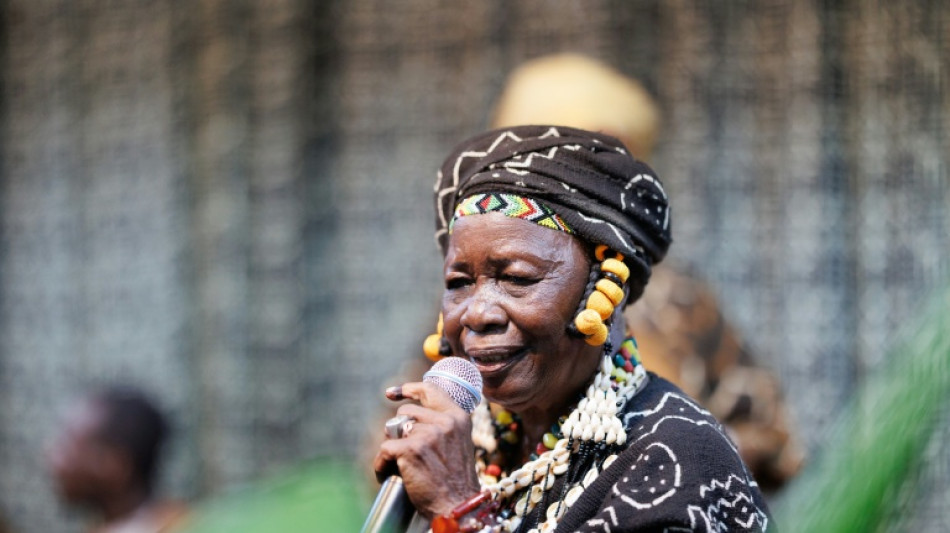
Malian songbird keeps age-old sounds alive at 88 / Photo: - - AFP
At the age of 88, barefoot and cinched into a belt of cowrie shells, renowned singer Mariam Bagayoko still sweeps across the stage with infectious energy, dazzling wide-eyed fans with the rhythms of a bygone Mali.
Beloved at home and abroad, the "Nightingale of Beledougou" has spent a lifetime carrying the traditional music far beyond her homeland, fighting to keep it alive in the modern world.
At Bamako's Palace of Culture, Bagayoko spun like a top, her knees bending and body dipping low before springing back up again as she threw her head back and forth.
In her right hand, she gripped a yabara, a percussion instrument made from a large calabash filled with dried seeds that rattled sharply as it struck her left palm.
The sound blended with the deep notes of the n'goussoumbala, a large xylophone-like balafon unique to the Beledougou region of central-western Mali, long known for its rural musical traditions.
Moments before, she had clasped her hands behind her back in a show of respect to protective spirits and griots, the guardians of the spoken word, before launching into powerful Bambara songs that evoke moonlit village gatherings.
A towering figure in Mali's music scene, Bagayoko has spent decades bringing little-known local traditions to audiences around the world.
In late 2025, she received a lifetime achievement honour at the Aga Khan Music Awards in London, emerging as one of 11 final laureates selected from more than 400 candidates across Africa, Asia, the Middle East and Europe.
The jury, which included Malian star Oumou Sangare and renowned Catalan early-music master Jordi Savall, praised her "passionate and unwavering dedication" to preserving and passing on Mali's musical heritage, especially to women and girls.
- Sang before she spoke -
Born in Kolokani, north of the capital Bamako, in Beledougou, where music and dance follow every stage of life from farm work to ceremonies, Bagayoko said she learned to "sing before I could speak".
As a child, she would trail village women as they pounded shea nuts for butter, labour that was always accompanied by song.
"I joined them with my little calabash and sang along," she told AFP.
"At first, nobody paid attention to me. But little by little, my presence became indispensable."
Those simple melodies would eventually make her one of Mali's best-known ambassadors of traditional music.
Yet her father, a musician and performer in traditional local koteba theatre troupes, was against her musical ambitions.
"He was afraid that if I became successful too quickly, I would not live long, that I might be poisoned out of jealousy," she recalled.
- 'Future in good hands' -
Drawing on old songs from her country, Bagayoko's music comments on social issues and offers advice inspired by current events.
"It is the artist's privilege to be able to speak out," she said.
"Through song, we give lessons without hurting people, even when they see themselves in what we're saying."
One of her most famous performances is of the song "Ciwara", a tribute to the courage of farmers and the value of hard work.
She is also known for dancing atop the wooden keys of the n'goussoumbala, turning the instrument into a stage of its own.
Much of her reputation rests on her efforts to keep Bambara music and dances alive.
"I have trained many young people who have gone on to forge their own paths and are still grateful to me," she said.
"The idea is to make sure none of this disappears."
Bagayoko worries that traditional music is losing its "intrinsic value" as technology and foreign influences reshape local sounds.
"Today, the n'goussoumbala and the yabara are still present in our music," she said.
"But you no longer hear the rhythms of our homeland. The younger generation has modernised them and adapted them to rhythms from other countries."
Through her cultural project "Tiebilentie", she has helped revive an acrobatic masked dance once reserved for ritual ceremonies, bringing it to weddings and celebrations in Mali and abroad.
Bagayoko now takes comfort knowing that, through her children and younger people, her legacy will outlive her.
At her concert in Bamako, "my daughter sang and danced for the audience just like me", she said with a smile.
"She even got up on the balafon... the future is in good hands."
M.Eder--SbgTB