Researchers Uncover Remains of Ancient Imperial Medical Facility in Kyoto
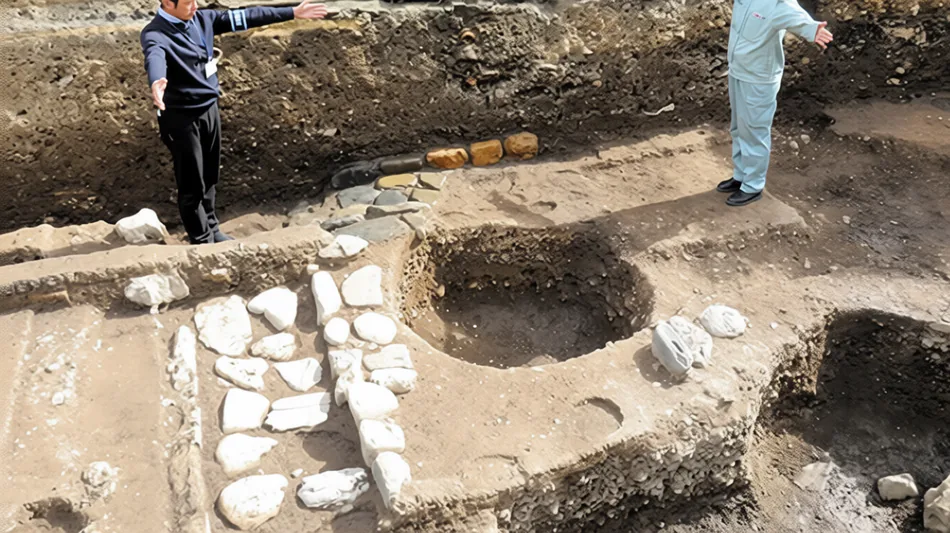
Archaeological excavations in Kyoto’s Kamigyo Ward have revealed the apparent remains of Anpukuden, an ancient facility where court physicians served the emperor. The discovery of a stone-lined rainwater ditch and postholes provides the first solid confirmation of the building's location within the Heian-period imperial residence.
Archaeologists in Kyoto have uncovered the apparent remains of Anpukuden, a historic facility where court physicians and medical officials served the emperor during Japan’s Heian period. The discovery provides the first solid physical confirmation of the building's existence within the grounds of the former imperial residence.
The site was located in Kamigyo Ward, at the center of Heiankyo, the ancient capital that functioned from 794 to 1185. Historical documents have long described Anpukuden as a critical component of the Dairi, the innermost section of the imperial palace where the emperor resided and performed state ceremonies. The facility was designed to house physicians and staff responsible for the monarch’s medical care and pharmaceutical needs.
During an excavation survey, researchers identified a rainwater ditch stretching from east to west as the primary remaining structure. The ditch is lined with flat river stones along its bottom, a structural characteristic that researchers attribute specifically to the Dairi complex. The stone-lined section measures approximately 2.75 meters in length.
Tamiki Kunishita, a professor of archaeology at Ryukoku University, noted that while much of the central facility's layout remains unclear, this discovery offers valuable leads for understanding changes in the ancient palace. "Anpukuden was an important facility of Dairi," Kunishita said. "Heiankyu’s Dairi was burned down many times and was eventually abolished. The recent discovery provides valuable leads for researchers to study changes in the ancient palace."
The city government presented the site to media outlets on October 28. Old documents indicate that Anpukuden was situated southwest of the main Shishinden hall, which remains a feature of the present-day Kyoto Imperial Palace.
Further analysis of the excavation site revealed a layer containing burned soil and carbides, dating between the 10th and 11th centuries. Historical records show that an order was issued to rebuild Anpukuden after the Dairi was destroyed by fire in 960. Kunishita stated that the ditch may have been constructed at least during or after that year.
Additionally, researchers found a large posthole on the north side of the ditch, with sides measuring approximately 1.8 meters. The timing of this posthole is estimated to coincide with the construction of Heiankyu, suggesting that Anpukuden once stood on or near this specific location. A previous survey at the site had identified ruins of a gate indicating the central north-south axis of the Dairi.
The Dairi complex was reportedly burned down and rebuilt numerous times over the centuries before being abolished in 1227 during the Kamakura period, while it was undergoing reconstruction. The current findings help clarify the spatial organization of the imperial residence during a period when its details were previously obscured by repeated destruction and rebuilding.
U.Preininger--SbgTB