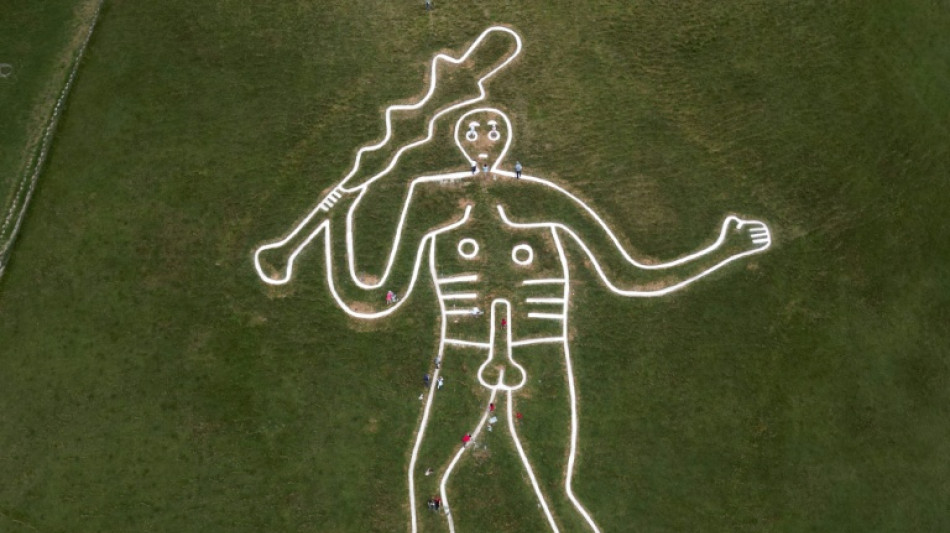
British naked chalk giant gets spruced up / Photo: Ben STANSALL - AFP
Getting hot and sweaty in a British heatwave, volunteers from home and abroad have been hard at work all week to restore a historic naked chalk giant dubbed "Rude Man" on a hillside in southwest England.
The 180-foot (55-metre) Cerne Abbas Giant, carved into the side of a chalk hill in Dorset, is restored around every decade to prevent it from fading into the grassy landscape.
"Typically, we carry out this work every 10 years, but we noticed it was starting to look a bit dull and needed some attention," Liz Flight from the National Trust heritage conservation charity, adding that it was last given a makeover in 2019.
Flight noted that heavier winter rains were washing away the chalk and increasingly frequent heatwaves had hastened the growth of algae and weeds, blurring the giant's obscene outline.
The giant is formed of a series of trenches carved about 30 centimetres deep into the underlying chalk hill, complete with a 10-metre-long erect penis.
Its origins remain shadowy, with National Trust research in 2021 revealing that it was likely carved during the late Anglo-Saxon period, between 700 and 1100 AD.
Volunteers from far and wide were hard at work on Friday.
"Some come from the nearby village, others from London, and even from as far away as Australia," said Flight, adding some 300 people had been gathered for the two- to three-week-long project.
This year, the makeover coincided with a heatwave which broke UK temperature records for May, disrupting the schedule. Rainfall expected this weekend could also slow down progress on the site.
Before applying new chalk, the old layer is removed and placed in plastic bags. Volunteers then walk down the hill, bags of chalk slung over their shoulders.
Some, wearing shorts and caps to protect from the sun, weeded a section of the trench. Flight, for her part, spent part of her morning working on one of the giant's legs.
This year, the cleanup has a special significance: a fundraising campaign raised £330,000 pounds ($444,500) to purchase over 130 hectares (320 acres) of land surrounding the giant.
The purchased site which has "high archaeological value" will allow the National Trust to explore the surroundings and help trace the history of the Cerne Abbas.
Researchers have long speculated about the identity of the giant, with theories that it could be an ancient symbol for fertility, or a likeness of the ancient Greek hero Hercules.
photo-adm-aks/ach
B.Schellnegger--SbgTB