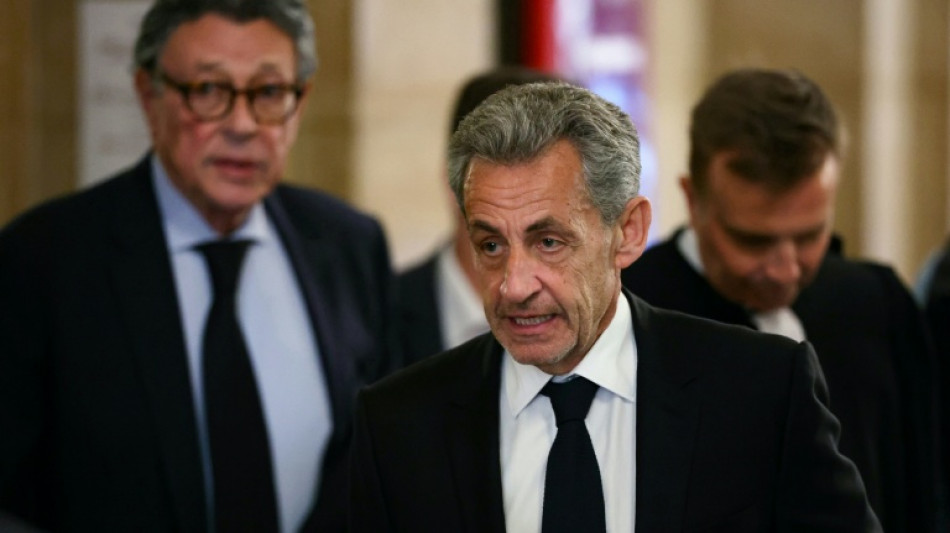
Appeal trial opens for France's Sarkozy over alleged Libyan funding / Photo: Alain JOCARD - AFP
Former French president Nicolas Sarkozy was back in court Monday for a retrial on charges he sought Libyan financing for his 2007 election, in a case that last year saw him become France's first modern-day head of state to go to prison.
A lower court in September found the right-wing politician -- who was president from 2007 to 2012 -- guilty of seeking to acquire funding from Muammar Gaddafi's Libya for the campaign that saw him elected.
Sarkozy -- who has denied any wrongdoing -- in October entered a Paris prison, serving 20 days before he was released pending the appeal.
The 71-year-old entered the Paris Appeal Court ahead of Monday's hearing, shaking hands with police and lawyers before taking his seat in the front row of the dock.
In the retrial, set to run until June 3, the former head of state is once again presumed innocent.
Sarkozy has faced a series of legal issues since leaving office and has already received two definitive convictions in other cases.
In one, he wore an electronic ankle tag for several months, until it was removed in May last year, after being convicted for trying to extract favours from a judge.
And in the other, he will have to serve more time over illegal financing of his failed 2012 re-election bid.
In the so-called "Libyan case", he has appealed a five-year prison sentence.
A lower court in September convicted Sarkozy of criminal conspiracy over what it said was a scheme to acquire Libyan funding for his 2007 presidential run.
But it did not conclude that Sarkozy received or used the funds for the campaign.
His legal team immediately appealed, but the lower court ordered him to be sent behind bars, citing the "exceptional gravity" of the conviction.
On October 21, he became the first former head of a European Union state to be incarcerated.
- Prison diaries -
In the initial trial, prosecutors had argued Sarkozy's aides, acting in his name, struck a deal with Gaddafi in 2005 to illegally fund his victorious presidential election bid two years later.
Investigators believe that in return, Gaddafi was promised help to restore his international image after Tripoli was blamed for the 1988 bombing of a passenger jet over Lockerbie, Scotland, and another over Niger in 1989, killing hundreds of passengers.
Members of Sarkozy's circle did not wish to comment before the retrial.
Sarkozy published a hastily written book about his time in prison titled "Diary of a Prisoner", with supporters lining up around a city block in Paris to buy a copy when it came out in December.
In the 216-page book, he recounts his mundane struggles with noise and low-quality food.
But he also hints at a possible alliance between the traditional right-wing Republicans party he once headed and the country's main far-right party to "rebuild the right".
He and his wife, singer and model Carla Bruni, face another possible trial over allegations that they tried to bribe a key prosecution witness in the Libya campaign financing case with the help of a paparazzi boss. They deny wrongdoing.
burs-ekf/ah/rmb
N.Hinterseer--SbgTB